

How To Repair A Speaker That Has A Distortion Sustain Fuzzy Sound
A diddled speaker is a huge annoyance. It starts with noticing the sound and wondering if you're imagining it until the trouble gets worse. So you lot wonder if information technology's likewise late to prepare information technology. I'm going to explain what it sounds like, why it happens, how to test for it, and how to gear up information technology if possible...
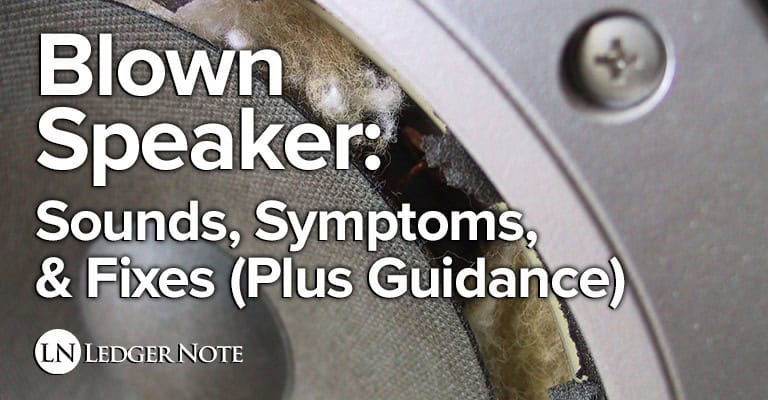
No matter if you're talking about car speakers, studio speaker monitors, a guitar amplifier, or even some cheap computer or TV sound arrangement, blown speakers are frustrating. And doubly and so when you realize that if you'd caught information technology soon enough y'all could take saved information technology.
Well-nigh of the time we want a matching stereo pair then that can mean replacing two if it'south in a sound system where the quality really matters, and this tin can go really pricey if we're talking virtually an entertainment centre or a critical listening setup for mixing, mastering, or recording sound.
You're here so you probably take some indication that you're dealing with a problematic speaker. It could be blown out or have a problem within the ability amplification stage. We'll sort information technology all out and I'll give you some professional person guidance on how to proceed once you know exactly what the deal is.
I'm going to keep this 1 simple (non get also technical) since if you already know about this topic you won't be searching for it anyways. This one is for the regular people out in that location, and the artists playing amplified instruments, not the studio engineer types.
How to Tell if a Speaker is Blown
Generally y'all'll hear the term diddled speaker used to draw whatever tweeter, woofer, or subwoofer that doesn't sound right or flat out isn't working at all. It'south not too big of a deal if information technology's a inexpensive pair of headphones or a car speaker, but what if information technology'due south your guitar amp and you have a gig that night?
First and foremost, without getting overly technical, permit'south phone call it a blown out speaker if:
- Information technology produces baloney
- Makes no sound at all
- The cone is physically torn
An unpleasant, bad audio can be a problem with the power source or could mean at that place'southward a pocket-sized tear on the cone that can become worse over time. If no sound is being fabricated at all, you take an electric trouble at hand. You could also have a problem with proceeds staging (explained below).
The real problem is if you're unsure nigh information technology because the modify in sound quality is very subtle. You lot desire to catch it before it gets worse and/or brand sure you're getting the all-time experience possible (for amusement or worse, actual professional piece of work). Allow's talk about the actual sound from a bad speaker.
What Does a Diddled Speaker Audio Like?
Think about the 1960's and 1970'due south rock era when guitarists like Jimi Hendrix used fuzz pedals, overdrive pedals, and distortion pedals to extreme degrees. That buzzing sound was originally created by purposefully playing through a speaker with a torn cone.
That's the sound y'all're probably hearing but at a much more than subtle level. It sounds similar a bunch of bees buzzing effectually or a scratching audio interspersed with the rest of the sound. If you've heard digital clipping then you're familiar with what I mean.
1 reason information technology tin be subtle and difficult to hear is that this distortion may be quietly embedded in the audio. Some other reason is that this noise follows the same pitches that are being produced by the music or voices beingness played back.
You'll have to mind closely if it'due south not glaringly obvious. It helps to mute the other speakers and mind but to the problematic one. You tin do this with the panning settings in your car's radio panel, on your entertainment middle'southward receiver, or in your digital audio workstation software on your figurer.
What Blows Out a Speaker?
Before we become much further, permit's talk almost what exactly causes this problem. It all boils down to electric power and providing as well much. And that happens in one of three stages or all of them:
- Hot source material
- Amplification
- Volume controls
Let me intermission downwardly each scenario, how frequently it happens, and what exactly causes the problem.
About Common: Abused Equalization & Volume
In most cases, especially for automotive speakers or entertainment system speakers, what happens is the equalization system is abused before turning upwardly the music extremely loud.
For case, if you were to navigate to the subwoofer settings and turn information technology all the mode while also boosting the bass and reducing the middle frequencies and the treble, and then turn the volume up actually high, you could easily tear the cone on your subwoofer.
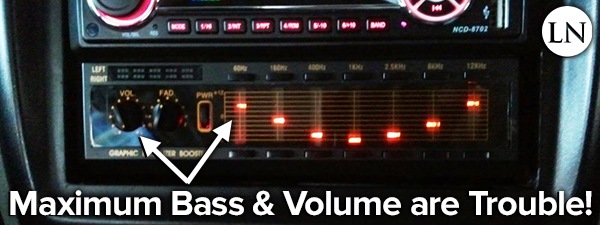
The same goes for your other four speakers. They are designed to be used at varying volumes, even very loftier ones, but if y'all alter the frequency response using the blaster settings outside of the normal range of use, you lot tin can blow out a speaker very easily at loftier volumes.
Less Common: Mismatched Speakers & Amplifier Ability
If you lot prepare upward your sound system without paying attention to the specifications, yous could underpower or overpower your speakers at the amplifier. Both of these scenarios lead to clipping, which leads to unnatural motion of the cone and coils, but each also take their own unique dangers.
Underpowered speakers tin can misconstrue through amplifier clipping (as can overpowered ones). This ways that the audio is now being outputted more than similar a square wave than a smooth sine wave, which is extremely jarring to the cone to reproduce and reduces speaker life drastically.

What happens is you plough up the source fabric and amp higher and higher since it tin't meet the ability rating of the speakers, which leads to sound clipping. The exact same distortion happens with an overpowered speaker merely at the speaker-lever instead of the amp, because it'due south being over-driven.
In both cases the average power will be college than intended, and over the course of time this can atomic number 82 to heat harm at the coils. Somewhen your speakers can stop working birthday. Overheating is a common cause, leading to thermal failure. Rarely is it ever just mechanical failure.
When speakers are overpowered you can cause the cone to leap out of its normal range of movement and do so in such a violent, repetitive fashion that you tear the cone. I've had this very thing happen to a subwoofer when I let a friend borrow my car and he decided to play with the EQ on the radio.
Guitar amplifiers and ones for like instruments don't need to worry near this. They're manufactured in such a way that you won't meet these problems.
Very Rare: Hot Source Fabric
Even in the days of burning CDs are making mixtapes for the auto was it rare to take this problem. Source material refers to the mp3 files you'd play off of a CD or through your smart telephone with the aux cable.
Nearly people volition play them at maximum volume on the smart telephone or fire the tracks equally they are to the CD. This is expert and proper proceeds staging. Some people discovered that if they contradistinct the audio files on the computer before called-for the CD or uploading to their phones that they could "enhance" the bass.
All they actually did was innovate clipping at the source material, before the amplifier and speakers. So even at normal listening volumes the speakers have to contend with clipping, and much more so at loftier volumes. Again, this is rare. As long as you oasis't altered your source cloth y'all're fine.
But for people listening at a reckoner, be careful for software programs that allow you increase the book as high as 200% to 300%, like the VLC motion-picture show and music actor, for case. That's the problem I'chiliad talking about. Don't do that, just turn up your speakers themselves.
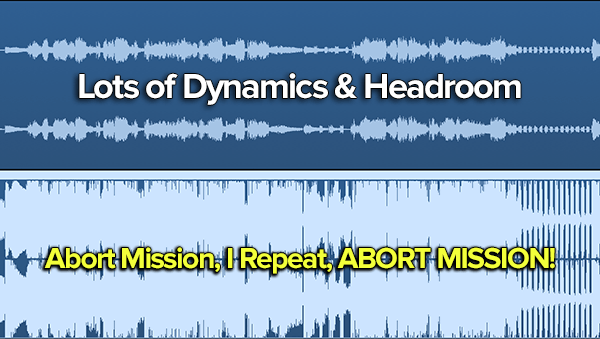
To understand exactly why this is a trouble, I've added an prototype in a higher place, but if you actually want to get into information technology, read our commodity on Gain versus Volume to sympathize the divergence and how ane can damage your sound arrangement.
Blown Speaker Symptoms
Here's a listing of the issues you'll encounter if you have a blown out speaker on your hands. Some volition exist more than subtle than others, and it all varies depending on just how damaged your unit is.
Baloney at Normal Volumes - If fifty-fifty at moderate volumes you hear hiss, static, and fuzz, so y'all take one of two bug on your hands. You either have loose or damaged voice coils or you have a torn cone. If you plough up the volume the problem should get worse.
Lack of Cone Vibration - The cone of a speaker moves quickly in social club to push air effectually to create sound. If it'due south not vibrating (regardless of the volume) then it isn't receiving power. This means you either take a wire that has come up loose or a malfunctioning chemical element within the speaker assembly.
Incomplete Frequency Response - An incomplete or inaccurate frequency response is a sure fire sign of a blown woofer. This means that y'all're hearing less bass or high frequencies, as examples, from this speaker than from others in its set.
Rattling, Popping, & Noises - Past the expected baloney, you can hear popping out of blown tweeters, rattling from a flopping cone fabric, or a misbehaving voice coil. Pay attention specially when you know it isn't a problem in the source textile, like a CD skipping when you ripped the anthology to your computer equally mp3 files.
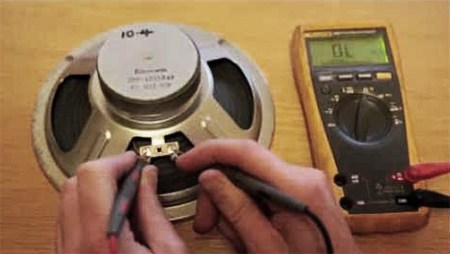
Infinite Impedance at the Coils - For the more technically inclined, you tin use a multi-meter to exam the impedance at the phonation curl. If it's well-nigh infinite then y'all obviously have an electrical problem on your hands. Information technology should commonly exist in the range of four to ten ohms for virtually cases.
Diddled Speaker Examination
If you aren't getting whatsoever sound then you lot take a asunder wire, a shorted wire, or a fried voice gyre. Here's what you lot should do to determine if your speaker is busted, otherwise:
Exam #i - Visually Inspect the Cone
Get-go, remove the grill and anything else needed so you tin visually detect the cone. If yous run into that the cone is ripped or that it has separated from the foam around its outer diameter, then yous don't demand to test anything.
That foam naturally disintegrates over fourth dimension with use and is ofttimes the culprit if you lot don't abuse your sound system. You may simply have an old sound system that has left this earth due to natural causes (former historic period).
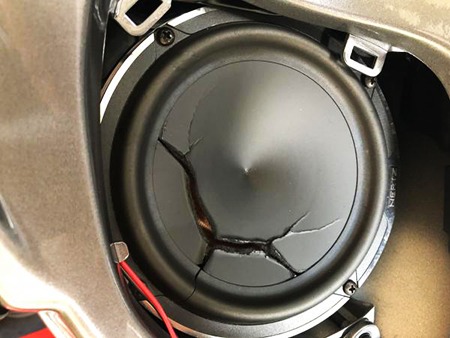
If that's the case, then I'd supercede them all anyways. Fixing one just ways you're waiting on the next to croak. And they all probably have spiders living in their assemblies and bug carcasses and even a lizard skeleton in there.
Examination #two - Listen Closely for Distortion
Back to the discussion on purposeful distortion. It'south currently achieved through pushing besides hot of a signal through the speaker (digitally or analog similar at the vacuum tube, if you have one). This could be, hopefully, what is happening to you which is a problem of proceeds staging.
If the music you're playing isn't from the official source, like a blu-ray disc, a music CD, or an officially downloaded sound file, and so run this test again with ane that you know for sure hasn't been contradistinct by someone. The gain could be as well hot in the version you have.
Otherwise, if you lot hear distortion at moderate volumes in any of the cones or tweeters, you have a problem. Heed closely to each individual woofer to determine which one is toast. If you discover fifty-fifty one, then read below for my guidance on what to do next.
Test #3 - Playback & Record
Yous'll have to mind closely to decide if there's a problem. It is possible to play a perfect sine wave through the speakers and record it with an impeccable microphone, but this too requires what is substantially an anechoic chamber or at least a really nice recording studio with a lot of audio-visual treatment.
Obviously this isn't viable for 99.9% of the people reading this. If y'all're in a professional person recording or listening environment then this may be possible and y'all know what to do without further explanation. Any alteration in the original sound being played means your speakers aren't faithfully reproducing information technology.
How to Set a Blown Speaker
Of grade, the first question is always "can you fix a blown speaker?" Yes, you lot can, but information technology's rarely recommended to practice-information technology-yourself. DIY speaker fixing is usually quick and dirty and only done on speakers you don't actually intendance almost having perfect quality, such as in your xx year old car.
If your cone has ripped or separated from the fabric surrounding it, y'all tin utilize silicon condom gel to glue it back together. It's important to use silicon because it'southward flexible, otherwise you'll just cause another tear. This gel comes in tubes like a caulk and tin be found at Walmart, Abode Depot, or any other hardware store.
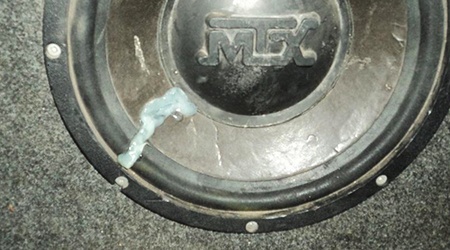
Some people will even get as far as to bosom out a needle and thread to sew the ripped cone and then reinforce information technology with normal full general purpose glue. I'm sure you can understand already why that's a bad idea.
If yous're non getting any sound out of just one speaker, then trace the wiring all the style dorsum to the amplifier and run across if whatsoever take wiggled loose. If none of that solves information technology, and then you lot probably have a problem with the coils. Unless yous're a decent electrician, I wouldn't carp with trying to fix it.
If we're talking about an extremely expensive sound organization like monitors in a church, auditorium, or your best recording studio monitors, and so I'd accept a professional person repairman come up out and fix them. If nosotros're talking about computer or auto speakers, they're cheap enough to warrant but replacing them birthday.
What to Do Most a Diddled Out Speaker
Yous have two choices: repair or replace. I provided guidance in the section above about when I'd attempt to repair them either myself or hiring a professional to exercise information technology. Nearly of the time you're going to want to replace the whole ready.
The reason is, the speakers need to be expensive enough to warrant a repair, and that means re-coning. Re-coning ways non but replacing the cone only the unabridged associates including the voice coil. And if nosotros're talking virtually sensitive, flat frequency response monitors and then yous no longer have a stereo pair.
If nosotros're talking most one of 10 speakers in an auditorium then past all means fix the one cone assembly. If nosotros're talking nigh your $30 headphones or computer speakers then just buy a new setup. You'll enjoy the change and it'll save you a ton of time and wasted money otherwise.
And that's all she wrote. In most cases my advice is to listen for distortion at normal levels and await at the cone itself, and if at that place's any indication that you take a blown speaker on your hands, just cough up the cash to replace it. You'll be happier than you would with the hack job of a DIY repair.
Jared H.
 Jared has surpassed his 20th year in the music manufacture. He acts as owner, editor, lead writer, and web designer of LedgerNote, as well equally co-author on all articles. He has released 4 contained albums and trade to global sales. He has also mixed, mastered, & recorded for countless independent artists. Acquire more well-nigh Jared & The LN Team here.

Source: https://ledgernote.com/columns/studio-recording/blown-speaker/
Posted by: herbertxylaw1937.blogspot.com
0 Response to "How To Repair A Speaker That Has A Distortion Sustain Fuzzy Sound"
Post a Comment