

How To Repair Buckling Stucco
 Asphalt Siding
History, patterns, inspection, repair, replacement of cobblestone siding
- POST a QUESTION or COMMENT about asphalt-based building siding products
InspectAPedia tolerates no conflicts of interest. We have no relationship with advertisers, products, or services discussed at this website.
Cobblestone edifice siding:
This article provides photographs of asphalt-based siding products and discusses common defects observed in asphalt outside building siding, such as buckling, splitting, cracks, odors, and questions about the demand for a vapor bulwark behind cobblestone siding and over building sheathing. Included are comments from several recognized building inspection and construction authorities.
We also provide an ARTICLE Index for this topic, or yous tin try the page top or bottom SEARCH BOX equally a quick manner to find information y'all need.
Asphalt Siding Concerns, Defects, Vapor Barriers, Inspection, and Diagnosis
 Asphalt building siding became a popular building renovation alternative to painting weathered or rotted forest clapboard or wood shingle siding as early on as the 1930's, becoming popular in the 1940's and the 1950'south in North America where it was used both for depression-cost housing and for covering the deteriorated outside walls of older homes.
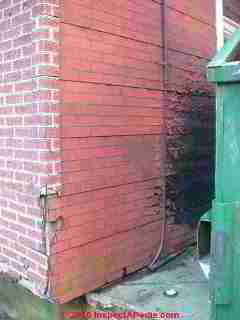
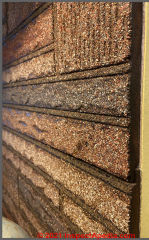
Asphalt building siding products are typically composed of asphalt shingle-like material: colored mineral granules bonded to an organic or wood-product base of operations with asphalt. Colored mineral granules form a desired pattern such every bit the false-brick shown hither.
Here we provide identification photos of several types of asphalt-based building siding and we list asphalt-sided building inspection, diagnosis, and repair suggestions.
Nosotros discuss asphalt siding damage, defects, and repairs, cobblestone siding installation defects and its event as a vapor barrier on the exterior wall of a building. We besides talk over asphalt siding leaks and rot risks.
We include a brief history of the evolution, patterns, brands and colors of faux brick and fake stone siding, offer clues ab out what is probably underneath it.
We also review the possible asbestos content in this asphalt-impregnated felt production, and finally we address a common question: can I utilise asphalt roofing shingles as building siding?
Article Contents
- SIDING Cobblestone SHINGLE or SHEET
- ASPHALT SIDING HISTORY, DATES, NAMES
- Cobblestone Canvas SIDING PROPERTIES & PICTURES
- ASPHALT SIDING DEFECT CHECKLIST
- Cobblestone SIDING REPAIRS?
- Cobblestone SIDING CONTAINS ASBESTOS?
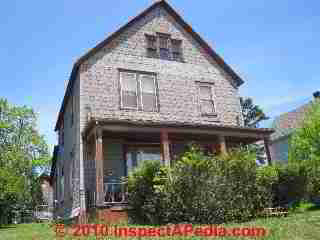
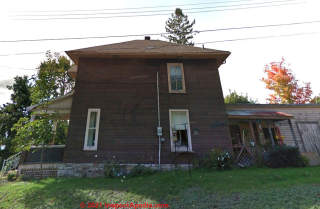
Our page top photo shows an asphalt shingle sided home located in Two Harbors, Minnesota. If you click to enlarge the picture show you'll come across that an apparent asphalt siding repair was made above the 2d floor windows.
Our Coolidge Hotel photograph shows (to a higher place-left) shows that the material can also be quite durable if properly installed and weather protected. [Click to enlarge any image]
A Little History of Asphalt Edifice Siding Products
 Cobblestone-impregnated felt fabric similar to roof shingles or cobblestone-impregnated felt bonded to hardboard or to insulating board was discussed as a building siding material in the U.South. as early every bit 1904 (Terpening 1904).
[Cobblestone-impregnated materials had been in use in a variety of forms for hundreds of years and had been in wide apply in roofing in North America since the 1840's.]
Asphalt-based siding resembling bricks was described by 1914 (Powell 1914) and further developed by Welty (1924).
Just asphalt-siding simply did not get widely popular in Northward America until the 1930's when the Mastic Corporation began marketing InselBrick, asphalt-based faux-brick siding panels.
The utilise of asphalt covering-like materials equally edifice siding no doubt grew out of the combination of un-sold asphalt roofing during the Great Depression in the U.S. and the lack of maintenance on homes during that period that left a need for an economical wall re-covering cloth.
Asphalt siding material was made in two common versions, one much like asphalt roof shingles but in larger sheets (right-side of the building photo near the acme of this article) and the other was comprised of an asphalt blanket laminated to hardboard siding material or laminated to a softer wood-based insulating board console, often sold equally InsulBrick or InsulStone siding depending on the manufacturer.
Usually made to look like brick (faux brick), asphalt edifice siding also appears in faux-stone versions (not to be mistaken for "perma stone" which has been sold since the 1960's every bit an exterior wall covering) and even in a wood-shingle lookalike, as well equally a utilitarian covering that was unabashedly plain asphalt sheeting.
Introduced in 1929 Sears sold brick veneer kit homes in the Honor-Bilt series
run across details at SEARS KIT Home IDENTIFICATION).
Eleven years subsequently, in 1940 Sears introduced a substitute for bodily brick veneer: Honor Bilt Brick Scroll-Type siding.
This asphalt siding was produced in 32" ten 43' sections, as a new add-on to Sears' four brick double lap siding that had first been marketed by the visitor 3 years earlier in both coil type and rigid type asphalt siding in brick patterns as a low-toll and durable building renovation cloth.
Asphalt based random stone pattern siding was developed and sold in a random rock design every bit early as 1943 when Sears produced grey Inselstone (Ashlar rock in some references).
Colored random rock pattern siding like that shown just above (Poughkeepsie, NY) was sold start in 1954, sold as Ranch Stone patterned cobblestone siding.
The development of the aluminum siding industry (introduced in the 1940'south) and afterward the vinyl siding industry afterwards Globe War II meant that few buildings of that later era were covered with asphalt shingle or slab fabric.
Cobblestone Sheet Siding Properties & Pictures
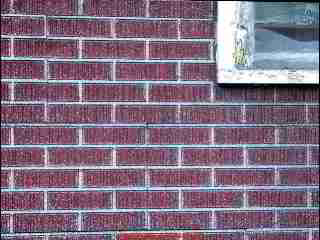
The instance of asphalt sheet siding in a cerise brick design shown in our photo above is from the Coolidge Hotel, White River Junction, VT.
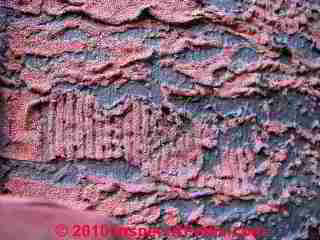
The random stone asphalt building siding shown just below is based on a hardboard substrate and is quite rigid when installed.
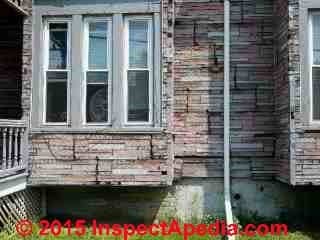
It would be rare to find asphalt-based exterior siding fabric as original wall cladding on a building; usually it was practical over wood clapboards which in turn were badly in need of pigment or repair.
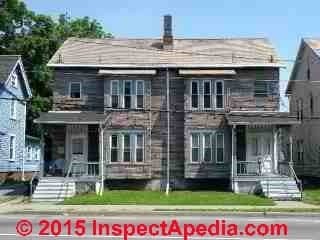
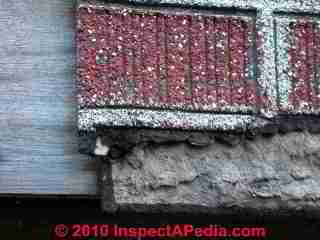
The asphalt-sided habitation shown but to a higher place, located in Poughkeepsie, New York, illustrates the usual wearable pattern: the faux-stone pattern asphalt panels weather at their edges where leaks ultimately begin.
At above right at the center of the photo at the bottom of the cobblestone-console siding you can run into the original clapboard siding on this domicile. The house was probably built earlier 1900.
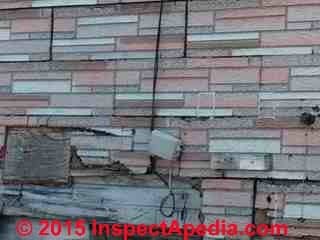
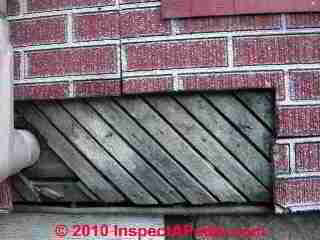
Above you lot tin see more details of wearable, actual loss of hardboard-backed asphalt siding panels, attempts at repair by nailing upward a plywood panel, and besides rotted wood siding.
Watch out: Don't fault mineral-granule-covered curlicue covering that may have been nailed-up on a building wall for an asphalt siding product. Covering products were not usually designed for apply on a vertical surface and are likely to exist found falling off unless extra nails were used.
You can easily spot roll roofing on a building because of its length - you will find long horizontal runs, perhaps 15 feet or more (rarely vertical) without seams.
Equally we show in our ASPHALT SIDING DEFECT CHECKLIST photographs (below), leaks into this exterior wall covering or mechanical impairment to information technology tin can expose the hardboard or woods-production substrate to weathering and disintegration.
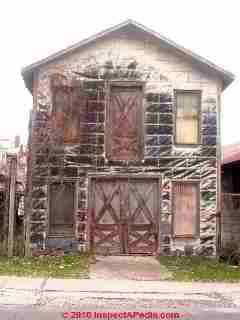
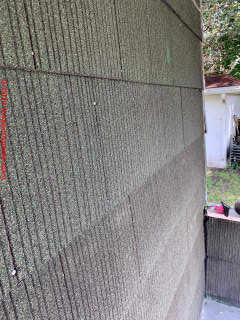
Only below we provide photographs of a thin asphalt exterior wall covering establish on a edifice in Hudson, NY. This cobblestone wall shingle product appeared to have no mineral granule blanket whatsoever.
Notice that the stunning number of roofing nails used to affix this outside asphalt cladding did not brand much departure in how the wall roofing endured.
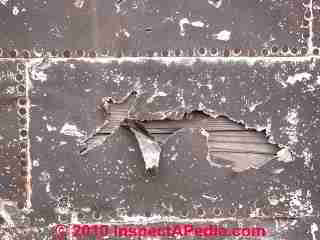
Asphalt Shingle Siding Backer Ingredients
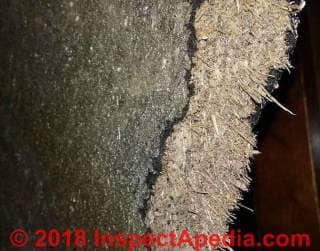
The photo above shows a woods-fiber based backer lath supporting asphalt-shingle siding. This photograph was included in a question by reader Tim who asked if this was cement asbestos siding - it is not. His question and our answer are
at ASBESTOS CEMENT SIDING FAQs .
Beneath is a dissimilar type of asphalt edifice siding installed - or rather falling off of - a building in Two Harbors Minnesota.
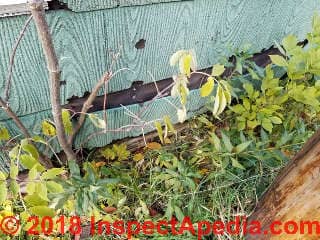
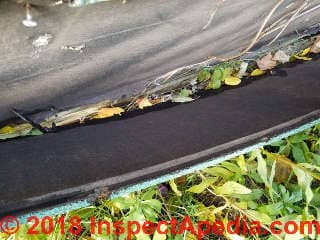
Above: our shut-up photo shows an asphalt-impregnated backer lath attached to the green asphalt shingle siding on this garage.
Cobblestone Siding Defect Checklist
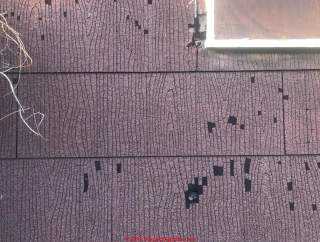
The two asphalt sheet siding photographs (beneath) testify two defects ofttimes found on older buildings: falling siding where nails have been removed or lost (below left) and mechanical damage or tears in the siding (below-right).
The asphalt siding production shown at below right (produced on an all asphalt substrate like to asphalt roof shingles) is different from the production at left (produced on a hardboard substrate). A closeup photograph of the hardboard substrate of this asphalt siding is shown at below-right.
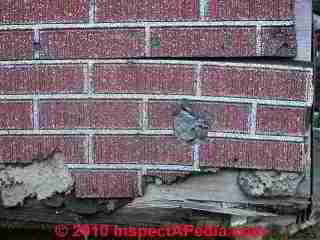
Asphalt sheet siding - paper substrate is shown in the photographs but below. Yous can see that this material may lose its granule blanket to betrayal the asphalt-impregnated felt or paper base.
Our photo below shows that this hardboard-based asphalt edifice siding was installed over wood lath. We pose that the original building wall had been covered past stucco.
Cobblestone Siding Repairs?
Loose cobblestone wall siding that is otherwise in acceptable condition can be repaired by re-nailing it to the building.
Do not leave openings in the building cladding that permit leaks and water entry (such as shown in our photographs higher up) as you will be inviting a rot, wood destroying insect, or mold problem in the structure.
If coin is short, a stopgap repair tin be made by patching over with roll covering or even a few roof shingles (and extra nails) as someone appears to have done in our photo (left).
If big areas of the asphalt building siding are worn-through, the proper repair is to completely remove the textile from the structure, audit for and repair whatever structural damage, followed past installation of a new exterior wall covering.
Tin I Still Buy Asphalt-Based Exterior Siding?
Question:
Can you tell me where to purchase simulated asphalt brick siding? I live in New York. - N. verizon.net
Reply:
Nosotros have not found whatever of the U.South. asphalt product manufacturers such as GAF, Certainteed, Oldcastle who currently produce asphalt-based building siding such as the brick-pattern you asked virtually.
The asphalt-based brick pattern exterior siding products found on some older buildings were generally produced by the aforementioned companies who produced cobblestone-based roofing shingles.
Asphalt-based [roof shingle fabric on an organic (paper mat) or cobblestone on hardboard] siding products were subsequently supplanted by cement-asbestos siding-shingles, then aluminum siding and steel siding, and then currently by vinyl siding.
We are hundred-to-one you would find a current supplier of new cobblestone siding products today, merely I'll continue to expect for such a source.
CONTACT u.s. if you find a modern source, use, and edifice-code approval for asphalt-based imitation-brick or similar pattern exterior siding.
Tin can I Employ Roof Shingles for Exterior Siding?
We do not recommend using roof shingles for exterior siding, merely if y'all are going to endeavor that anyway, be sure that you follow the appropriate vertical and most-vertical nailing instructions for the roof shingles. Otherwise you'll find them falling off of the building.
See SIDING Cobblestone ROOF SHINGLES on WALLS for details.
Does Old Cobblestone Edifice Siding Contain Asbestos
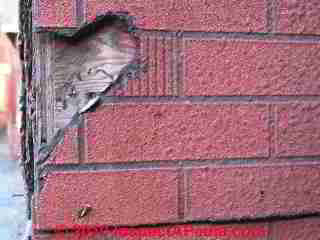 Reader question: I was merely wondering if the Brick looking asphalt siding e'er contained whatever asbestos or hazardous material.
Your opinion would be greatly appreciated.
I need to remove some of this product but will apply a pocketknife to cut information technology into pieces and bag it appropriately. Also i am having a room demo that is 20x38 and the drywall joint compound is suspected to have chrysotile asbestos contained.
I take taken appropriate measures and have sealed of the area with 6mil poly and taped the joints.
Should this upon removal be sprayed with water or are the asbestos crystals encapsulated in joint chemical compound. Have you come up beyond this situation. Thank-Y'all. D.T., Canada
(July 21, 2022) Kent W. Roeser said:
I accept asphalt simulated brick Finnish shingles on the back of my business firm how can I tell if they are asbestos? The house was built in 1920 and the addition was subsequently on. The owner said they were asbestos but with the seizures his retention is not there.
Answer: Maybe. Some does.
A competent onsite inspection by an expert might confirm the historic period and type of this particular asphalt-siding product, and also, based on the likely building age, it is certainly possible that other asbestos-containing materials are present. That said, here are some things to consider:
In general I retrieve you are referring to an asphalt product that is fabricated substantially of the same material every bit asphalt roof shingles, though some versions applied bituminous and asphalt and mineral granules to a hardboard base rather than a paper ("organic") base.
Some asphalt roof shingle products, and therefore quite possibly some asphalt siding products, did indeed comprise asbestos fibers in their substrate or coating. Roof shingles, even if the material independent asbestos (which information technology might) are rarely the but nor even the principal source of problem-levels of asbestos fibers in a edifice and I doubtable the same is true of asphalt-based building siding. That's because the asbestos fibers are encapsulated in asphalt or similar non-friable bases.
There might exist a business organization if building demolition is underway and the removal of old siding created dust - especially if power tools such as power saws or grinders were used.
Picket out: if that's going on with your building it would be prudent to use appropriate dust control measures and to minimize the pause-up of the material, and particularly, to avoid using power saws. And there may be provincial or local municipal regulations that govern the demolition and removal of these materials.
Kent some old asphalt covering and siding materials contained asbestos simply to know for sure yous'd need to send a small sample to a certified asbestos testing lab. If you can transport me some photos I tin can comment farther.
Enquiry on the History of Asphalt Siding Products
- Arkansas Historic Preservation Program, "Asphalt Roofing Materials" published by the Arkansas Historic Preservation Program, retrieved 2022/ten/08 original source: paragoninspects.com/articles/pdfs/outside/ cladding/siding/asphalt/ cobblestone-siding-materials-ahpp.pdf
- Beckman, Bernard C., "Blended siding." U.S. Patent one,674,630, issued June 26, 1928. Assignee Beckman Dawson Roofing Company
- Cowan, Clarence Percival. "Cowan." U.Southward. Patent i,655,494, issued Jan 10, 1928.
Excerpt:My invention relates to improvements in covering and siding structure and material for building purposes with more detail reference to prepared sheet surfacing cloth such as asphalt shingles and asphalt clap-boards and the object of the inventon is to devise an improved form of this lmaterial by means of which a superior construction may be obtained; ...
- French, Henry, "Strip shingle." U.S. Patent 1,732,403, issued October 22, 1929.
Excerpts:
This invention has for its object to provide a new grade of strip shingle which may be laid with others in overlapping rows to simulate laterally spaced individual covering units, to provide a new and pleasing pattern or effect,... - Jacobs, Frank Davis. "Covering and siding material." U.S. Patent RE12475, issued April 24, 1906.
- Jacobs, Frank Davis. "Roofing and siding material." U.S. Patent 788,358, issued April 25, 1905.
- Mullin, Thomas J., "Building material." U.S. Patent i,362,888, issued December 21, 1920. Assignee Richardson Paper Company.
Excerpt:
My invention relates to material to be used in the construction of houses or other buildings equally weatherproof fiber-lath siding, to take the place of Wooden siding and weatherboarding for the outer wall covering for houses or buildings. Wall board has been used for within structure in houses equally an iusidewall finish, simply for outside wall construction, newspaper or fibrous fabric has not heretofore been made available.It is accordingly the object of my invention to provide a material suitable for construction of exterior walls, made of paper board, which is formed up with additional material and provided with a finish or outer layer or coating of materialwhich will go far available as an outside wall construction cloth.
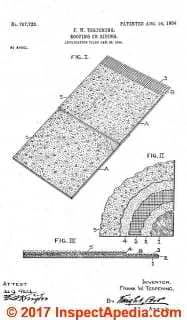
- Terpening, Frank W. "Roofing or siding." U.S. Patent 767,723, issued Baronial sixteen, 1904. [Click to enlarge any image]
Extract:My invention relates to that class of readymade rooting or siding which is composed of thou a series of layers of impervious material rendered waterproof b the application of cei [sic] reference to covering or siding sheets of this grapheme in which is incorporated a layer of wire fabric to add strength and resistance to wear incident to the handling and service of the roofing or siding. ...
A designates sheets of vmy improved roofing or siding, each ot' which is provided .at one finish with a lap surface B. rlhe rooting or siding sheets are each composed of a bottom layer 1 of fibrous wool-felt, onto which is laid a layer or coating 2 of cement, such equally asphalt
.Above the layer 9. of asphalt is a layer or sheet 3 of wire fabric, which is surmounted by a layer or blanket of cement, such as asphalt.
The layers'of` cement 2 and 4 permeate into the mes of the wire-fabric sheet iii and furnish adhesion between said wire fabric and the bottom layer of wool-felt, thereby rendering the grand sheet of rooting or siding intact throughout.
Onto the topmost layer 4 of cement Iapply a layer v of crushed granite, gravel, or other suitable granular fabric, which by embedding into the topmost layer of cement becomes an integral part of the rooting or siding sheets.
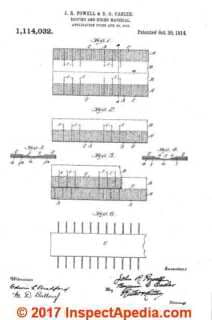
- Powell, John R., and Benjamin K. Casler. "Roofing and siding textile." U.S. Patent i,114,032, issued October 20, 1914.
- Welty, Peter P., "Siding and shingle strip for building purposes." U.S. Patent 1,515,530, issued November 11, 1924.
Excerpt:This invention relates to siding or shingle strips for edifice purposes composed of flexible, h2o-proof material and adjusted to be laid in overlapped courses, each strip constituting a fellow member of the roofing of the side of a building.
The master object of the invention is to provide a building strip of the class specified, constructed to simulate building units such as bricks and presenting, when a number of the strips are laid and overlapped,
a surface having the advent of a brick wall, and to utilize in connexion with these strips at inner and outer corner angles of the side portion of a building novel forms of supplemental strips having a particular specific construction,
to regularly continue the courses of the overlaid strips at the points indicated and preserve the continuity of the said strips at inner and outer angles.
7 A further object of the invention is to more often than not improve building strips of the character specified by forming the same from insufficiently inexpensive cloth and subjecting the strips to handling to render them water-proof, and thereby economize in the cost of building materials with substantially the same caste of efficiency in service and wearing power.
- Too see REFERENCES at the end of this article
Reader Q&A - also see the FAQs series linked-to below
@Rebecca Dietz,
It'southward not mutual to come across an exterior siding material used indoors, but certainly within the scope of what people might think of to do in their building.
You could spray-pigment the surfaces with a suitable sealant, followed past a finish blanket.
At ASBESTOS ENCAPSULANTS & SEALERS - you will find some products that can be applied over asphalt materials like asphalt mastic and that would doubtless piece of work on your cobblestone-impregnated felt or fiberboard-backed siding used indoors.
Watch out: I like the await but I would desire to
ane. ask the local fire inspector if she considers this a burn down-safe installation earlier doing whatever other renovations like painting or roofing-over these walls
2. consider laminating a layer of drywall over all of the surfaces if you no longer want to expect at asphalt siding; the advantages include a more-paintable surface, a burn safety improvement, and yet if someone comes along after us who wants to go dorsum to a 1930's await, you've preserved that bit of the dwelling house'due south history. (It's easy to remove drywall and but about impossible to remove paint on asphalt siding)
I should make clear that asphalt siding exposed as a terminate wall surface indoors may besides violate local fire and prophylactic codes.
Interlocking Asphalt-Saturated Wood Fiber Panels:
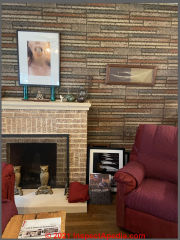
I believe this material was installed on the interior of my house, in the living room. Images attached for reference.
My house was congenital in 1930 in San Antonio, TX. Was this a common exercise to use the panels on interiors? Do you know if it is condom for interior employ from asbestos or other harmful ingredients ?
I have considered painting over it but suspect the pigment would bit off over fourth dimension every bit the ceramic granules embedded in the asphalt come loose. Whatsoever suggestions?
Thank you for your very interesting article on celebrated building materials!
@Ron,
"Can" may be a flake broad;
I'd say that a better installation would employ housewrap and furring strips to become a better wall, and you might need to build out window and door trim.
Tin yous install vinyl siding directly over vintage asphalt brick wall siding.?
@funkymusic14,
That looks like an asphalt-based siding product like those described on the page above .
Tin anyone aid me identify this siding?
@Petra Reinert,
Typically nosotros strap over existing siding when the walls are very uneven and we wouldn't have a good nail base.
A problem with strapping over one or ii times and installing new siding is that is your build out the wall you volition find of the windows and doors receive as sunken into the edifice and so y'all will want to build out the trim around all of those openings.
But of class there is the advantage of adding insulation to your building exterior
I was wondering what would exist the best to bargain with Inselbrick on the business firm we recently purchased. Should nosotros strap overtop and and so put hardboard insulation so strap again and then put siding, or is it preferable merely to strap it and put siding directly overtop.
 Thank you for the photos and question, Elvis.
Asphalt-based siding mounted on fiberboard was a widely-manufactured and distributed product for many years; to know absolutely whether or not your siding contains asbestos you'd demand, of course, to have it tested or at least to know whose production it was.
In general, the wood-based fiberboard capitalist is not an asbestos production, but asbestos was oft found in the asphalt-impregnated paper or felt backer that forms the base for the coloured mineral granules that form the brick "surface".
The fabric isn't highly friable and may not produce a measurable asbestos hazard until it's disturbed by grinding, chopping, sawing, demolition.
The research below may be helpful in making a further approximate about the use of asbestos in asphalt products in Sweden.
- Greider, Harold W., and Marion F. Smith. Asbestos sheet fabric and method of manufacture [PDF] U.S. Patent 2,567,558, issued September 11, 1951. Filed by Philip Carey Manufacturing Co.,
Excerpt:This invention relates to asbestos products and relates especially to products which comprise fibrous material containing asbestiform mineral fibers disposed in intimately contacting relation as by felting or other functioning adapted to form a sail or sheet-like body.
The asbestos products which find most extensive commercial employ are asbestos sail materials that are usually produced by water laying and that are generally referred to equally asbestos paper or asbestos millboard, which is referred to herein generally every bit paper.
The bulk of the asbestiform mineral fiber that is used in asbestos paper usually runs from about to A in length, although the fiber that is supplied for paper making generally contains a considerable quantity of shorter fibers of varying lengths and may contain a portion of longer fibers.
The nearly more often than not accustomed organisation of nomenclature of asbestos fibers is that of the Quebec Asbestos Producers Association.
The asbestos fibers which are virtually commonly used for the industry of asbestos paper are those which range from Group five or paper classification to the Group 'seven or shorts classification'of the Quebec Asbestos Producers Association, or mixtures thereof.
- Järvholm, Bengt, and Anders Englund. "The impact of asbestos exposure in Swedish structure workers." American journal of industrial medicine 57, no. 1 (2014): 49-55.
- Westerholm, P., Remaéus, B., & Svartengren, G. (2017). THE TALE OF ASBESTOS IN SWEDEN 1972–1986—THE PATHWAY TO A Near-Full BAN [PDF] International Periodical of Environmental Research and Public Health, 14(11), 1433.
Abstract:This paper provides a narrative of the national intervention strategy in Sweden aimed to restrict the industrial use of asbestos. For many years, asbestos was imported for widespread industrial utilize, resulting in big amounts throughout Swedish society.
In 1972, the whistle was blown in a Communist Political party parliamentary motion describing asbestos as a health hazard and requesting action to prohibit its use. Although the motion was rejected, it initiated the extensive charting of asbestos sources on a tripartite footing, involving authorities agencies, and employer and merchandise-union organizations. Restrictive asbestos management practices were enforced from July 1982.
The year 1985 saw the Government Asbestos Commission review, covering use-determining factors, international regulations, and assessments of cancer risks. The relative risks of chrysotile and amphibole were considered internationally (by the IARC), since chrysotile (a Canadian export) was regarded every bit unharmful in Canada at that time.
Prohibiting asbestos employ resulted in its virtual disappearance as an import to Sweden from the early 1980s. However, asbestos has undergone a transition from an occupational to a public-health hazard (although some work-related hazards, such as handling and disposal, remain).
The transition reflects the public'south exposure to existing stocks, in homes, workplaces, etc. Mesothelioma incidence has come up to exist regarded as an indicator of prevention effectiveness. View
Keywords: asbestos; asbestosis; lung cancer; mesothelioma; occupational take chances; public-health gamble; disease prevention
-
Give thanks you for the data on this site, it is very useful.
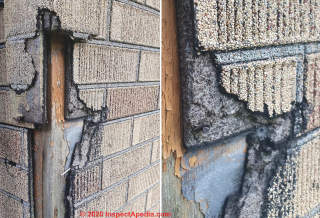
The photos [above] I attached to this comment are of yellowish faux brick siding on a house in Sweden.
The tiles are 5x5 "bricks".
It looks very much similar the InselBric siding you depict on this page.
I practise not know who manufactured them or what the brand proper noun was in Sweden.
I take non found any records of InselBric in Sweden. I have seen several smaller houses in the Swedish countryside with this yellow or crimson faux brick siding.
My question is, based on the photos, do you think this siding is based on wood-cobweb or asbestos?
My firm was wrapped in rolled roofing, what practice y'all call up, information technology currently has cedar siding over information technology
my dad installed looks like roof shingles for siding on our house, around 1970, is this better than vinyl or other fabric.. is it adequate to use?
Apologies, Ron, I'm not familiar with "rolled asbestos siding" - at least non by that term. Pretty much all asbestos-cement board-like products were produced in a rolling mill such equally that described by Mattison'due south 1911 patent.
And rollers imprinted a design on the siding.
Only the popular or familiar name (to me) is asbestos-cement siding - on older buildings, usually in a shingle form, not in long boards until the 1950s (Run across Read 1958 cited in our Asbestos Cement Siding page)
Besides the asphalt-based siding described above on this page, accept a await at
ASBESTOS CEMENT SIDING
and its modern replacement
SIDING, Fiber CEMENT - newer non-asestos cement-based siding
So to be sure nosotros're on the aforementioned "page", What are we talking about? A hard, rigid cementious shingle or lath product or a more than-flexible asphalt-based siding production?
Try again; My gramps had rolled asbestos siding on building fifty years. What similar product can be obtained today that is effective?
At that place are no modern cobblestone siding products that I've seen anywhere, nor would I recommend those, though some people smash roofing shingles onto building walls (they're probable to neglect).
Modern Fiber cement shingles (not the old asbestos-fiber-cement shingles) expect a lot like Marina's product below, and are very durable.
My grandpa had asbestos didn't on building fifty years. What is fabricated today that can exist used conveintly?
Aye, Marina, that'southward an asphalt-based shingle siding. Some cobblestone-impregnated (paper-based) siding materials incorporate asbestos.
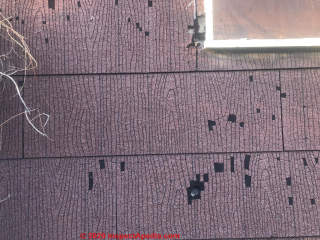
Simply wondering if this siding may have asbestos. The dwelling was built in 1940 in IL [Photo to a higher place]
...
Proceed reading at Cobblestone ROOF SHINGLES on WALLS or select a topic from the closely-related articles below, or see the complete Commodity Alphabetize.
Or see ASPHALT SIDING FAQs questions & answers about cobblestone based siding products that were posted originally at this page.
Or see these
Recommended Articles
- ASBESTOS CEMENT SIDING
- Cobblestone-ASBESTOS FELT
- ASPHALT ROOF SHINGLE ASBESTOS
- ROOFING MATERIALS, Historic period, TYPES - includes history almost aspalt roof shingles
- Ringlet ROOFING, Cobblestone & SBS
- SIDING Asphalt SHINGLE or SHEET
- ASPHALT ROOF SHINGLES on WALLS
- Asphalt SIDING HISTORY, DATES, NAMES
- Cobblestone Sheet SIDING Backdrop & PICTURES
- ASPHALT SIDING DEFECT CHECKLIST
- ASPHALT SIDING REPAIRS?
- ASPHALT SIDING CONTAINS ASBESTOS?
Suggested citation for this spider web page
SIDING Asphalt SHINGLE or SHEET at InspectApedia.com - online encyclopedia of building & environmental inspection, testing, diagnosis, repair, & problem prevention advice.
Or meet this
INDEX to RELATED Manufactures: ARTICLE INDEX to BUILDING SIDING
Or utilize the SEARCH BOX constitute beneath to Inquire a Question or Search InspectApedia
...
Enquire a Question or Search InspectApedia
Try the search box just below, or if you prefer, post a question or comment in the Comments box beneath and we volition respond promptly.
Search the InspectApedia website
Annotation: advent of your Annotate below may be delayed: if your annotate contains an image, web link, or text that looks to the software as if it might be a web link, your posting will appear after it has been approved past a moderator. Apologies for the delay.
Technical Reviewers & References
Click to Show or Hide Citations & References
Publisher InspectApedia.com - Daniel Friedman

Source: https://inspectapedia.com/exterior/Asphalt_Siding_Guide.php
Posted by: herbertxylaw1937.blogspot.com
0 Response to "How To Repair Buckling Stucco"
Post a Comment